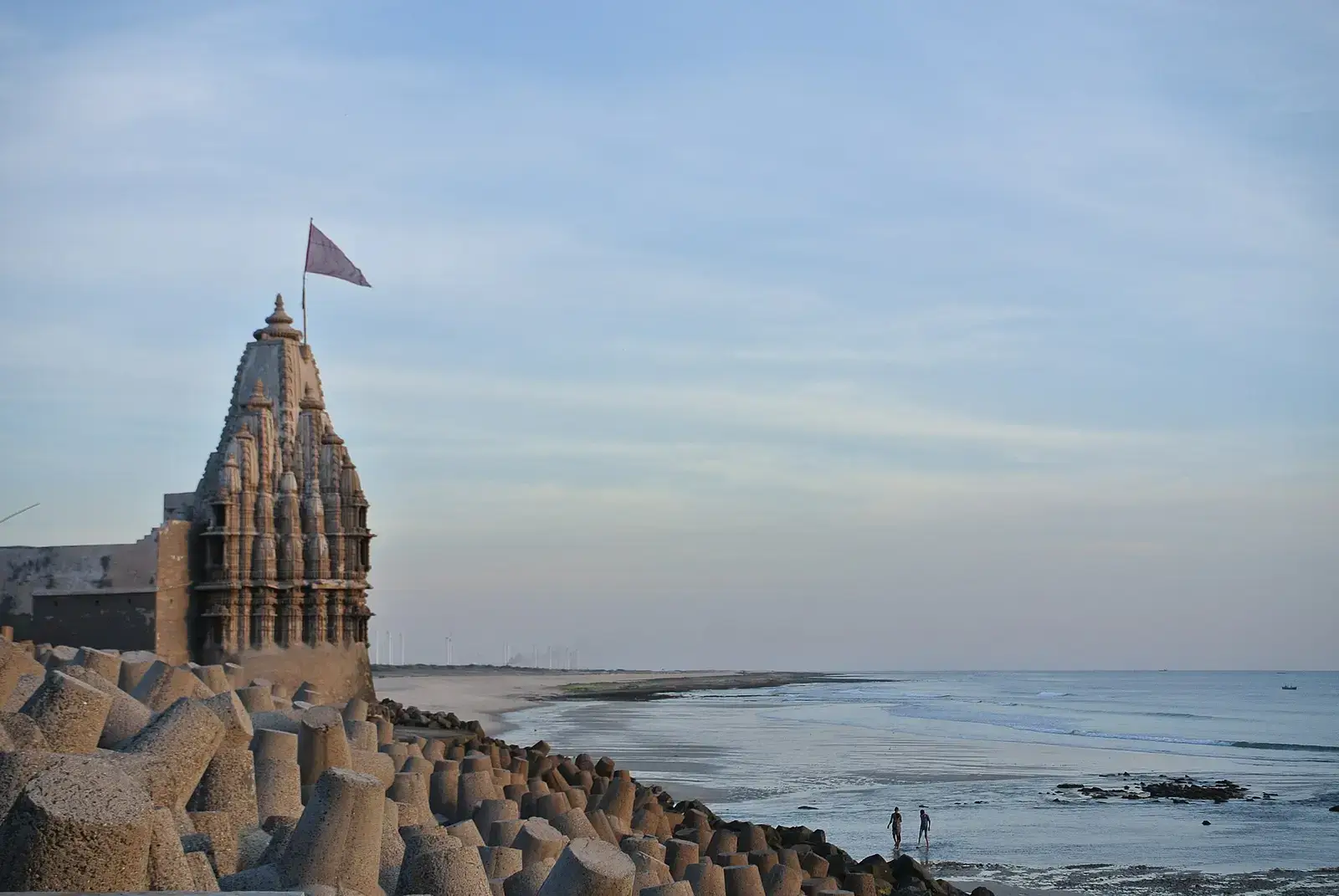
Somnath sits on the Arabian Sea at Prabhas Patan, and its story is one of repetition: built, sacked, rebuilt, sacked again, across roughly a thousand years. The temple standing today was completed in 1951, after independence, on the same ground as all the others.
That persistence is what people come for as much as the shrine itself. There is a marker on the temple’s seaward side noting that nothing stands between this coast and Antarctica — an unbroken line of ocean south. It is the kind of detail that stays with visitors.
It is also an easy place to visit: compact, well organised, and close enough to Rajkot to do in a single overnight.
The temple
The present structure is Chalukya style, built in sandstone, with a spire rising over fifty metres and a flag changed several times a day. The Jyotirlinga sits in the main sanctum; the queue moves steadily and is rarely as slow as it looks.
Aarti is performed several times daily and is the best time to be there — the building is designed for it, and the sound in the enclosed hall is part of the experience. Times shift seasonally, so check on arrival.
An evening sound-and-light show is projected onto the temple from the grounds, telling the history of the successive destructions and rebuildings. It runs after dark and is worth staying for; it is the reason an overnight beats a day trip.
Phones, cameras and bags are deposited before entry. Lockers are available at the gate.
Prabhas Patan, around the temple
Bhalka Tirth, a few kilometres away, is where Krishna is said to have been struck by a hunter’s arrow — the event that ends the Mahabharata narrative. It is a quiet site and takes twenty minutes.
The Triveni Sangam nearby marks the meeting of three rivers before they reach the sea, and is a traditional place for last rites. It is busy at dawn and calm at most other times.
The Somnath Museum holds fragments of the earlier temples — carved stone recovered from the successive demolitions, which makes the history considerably more concrete than reading about it does.
The beach beside the temple is public and pleasant in the late afternoon, though not a swimming beach.
Getting there and fitting it in
From Rajkot it is 185 km through Gondal, Jetpur and Junagadh — about three and a half hours on decent road.
The natural pairing is Gir, roughly two hours north, which makes a safari morning and a temple evening into a comfortable two-day trip. The other is Dwarka, 235 km up the coast through Porbandar, which turns it into a three-day pilgrimage circuit.
Diu is about two hours east, which some people add for a night of something completely different at the end of a temple trip.
When to go
- October to MarchBest timeThe comfortable window — mild days, pleasant evenings on the seafront, and the light show without sitting in heat.
- Mahashivratri, February or MarchFestivalThe temple’s biggest night, and extraordinary if you can handle crowds. Accommodation needs booking well ahead.
- April to JuneHotHot, though the sea breeze makes it more bearable than inland Gujarat. Early morning and evening only.
- July to SeptemberMonsoonMonsoon. Dramatic on the coast, and much quieter, though heavy rain can make the outdoor sites unpleasant.
Getting there · Plan this trip
Rajkot to Somnath — fares and drive time
We drive this route regularly, with fixed all-inclusive fares and a driver who knows the road.
Sedan, one way from ₹3,500